Every now and then, a band comes out of seemingly nowhere and delivers a debut album that knocks the music-listening world on its collective arse. It happened quite a bit near the end of the '60s, when rock 'n roll music was exploring a new consciousness. Bands like Led Zeppelin, The Doors, and The Jimi Hendrix Experience exploded on the scene with albums and sounds that continue to influence artists even today. We all recognize that these are bands that matter, but their respective debut albums remain -- in many ways -- their crowning achievements, and music hasn't been the same since.
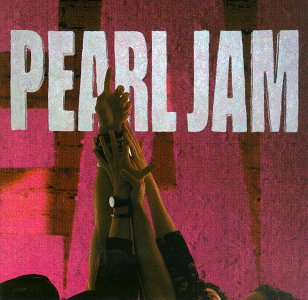
Fast forward to August of 1991. Guns 'n Roses were fun, Michael Jackson was still pretty "bad," and everything was comfortable in music. When a new band out of Seattle called Pearl Jam released a debut album that dealt with themes as varied as homelessness and incest, no one really noticed at first. But, after Nirvana's Nevermind whetted our music-listening ears for something new, the cream rose to the top and no one could get enough of Pearl Jam. Twelve years later it's still easy to see why, for the answer lies both in the abilities of the band members and the timeless songs they created on Ten.
I couldn't say when I heard the song "Even Flow" for the first time, but I can remember the first time that I recognized it as Pearl Jam's. The year was 1994, and I was not permitted to listen to any music other than classical in my parents' house... an environment not very conducive to discovering all the great music that was coming out at the time. So, when my best friend made me a tape of a bunch of Pearl Jam songs, I was very careful to keep it out of my parents' collective sight. I still remember my first listen to that tape. Huddled over my tape player, after waiting to hear my mom finish walking downstairs, I carefully pressed play -- all the while nervously fidgeting with the cheap volume control, hoping that a blast of music wouldn't bring my parents flying up the stairs. What I expected to come out of the speakers was a new, unfamiliar sound, but instead I heard a sliding, powerful guitar intro which sounded as familiar as the Mozart and Handel I had been listening to since preschool. This was Pearl Jam? I knew what this was. What I didn't recognize was the voice that soon joined the music, and the cumulative effect was one of amazed astonishment. By the end of the first chorus, I knew I had been given something special. This wasn't just a tape; it was an epiphany -- the beginning of a new life for me.
At a time when rock 'n roll was mostly about partying, sex, and decadence, Pearl Jam delievered a debut album that left behind the fantasies and addressed common, difficult themes and emotions that everyday people were experiencing. The longing of "Black." The pain of "Jeremy." The catharsis of "Porch" and the peace of "Oceans." On each of Ten's songs, Eddie Vedder sang in a powerful baritone full of vitality and charisma. Vedder's astounding vocal range, along with his other vocal abilities, constituted a voice that would prove to be the signature voice of the '90s (if not all of modern rock) and established him as one of the premier lead singers in rock history. Eddie Vedder wasn't just a gifted singer, he proved he was a talented vocalist by writing lyrics to match his singing abilities. Vedder sang about things that mattered, and he did so with an impassioned urgency and a vocal delivery that served to underscore the meaning behind the lyrics. When it was time to take a break from the pain of personal feeling, Vedder chose to narrate, much as in the fashion of Dylan before him. He created characters like the homeless man of "Even Flow," the serial killer of "Once," and the abandoned daughter of "Why Go," all the while addressing their emotions and adopting their perspectives.
Vedder's singing abilities notwithstanding, the forementioned lyrics would have been mere poetry without capable music to back them. In Stone Gossard, Vedder had a bandmate able to write melodies and craft song structures that added weight to the message of the songs. Gossard employed slide techniques, alternate tunings, and varied timing signatures, which, when paried with the amazing soloing abilities of Mike McCready, reached out and grabbed the listener with a force equal to that of the lyrics. McCready created solos that recalled those of Jimi Hendrix and Stevie Ray Vaughan, not only in sound but also in ability. Jeff Ament's use of the bass's entire fretboard resulted in full-sounding bass lines that matched with Dave Krusen's competent drumming to round out Pearl Jam's music and give Ten a deep, rich and complete sound. Although Krusen would leave the band, Pearl Jam had discovered a formula that would provide the solid foundation for their career.
Ten's closing track "Release" captured the entirety of the album's emotion, pain, frustration and celebration and exonerated all these feelings in one yearning, daringly hopeful chorus. I still remember the chill that went through me as Vedder's mournful "release me" filled my ears. It is a chill that revisits me each time I listen to the song. "Release" provided Ten with closure, and it did so in an awe-inspiring manner -- even as it simultaneously filled the listener with hope contrasted by despair. If a listener had any reservations about how well Ten could stand as an album, apart from a collection of great songs, "Release" silenced them.
I suppose I'm lucky that my first introduction to rock 'n roll, a watershed moment for me, happened to be with an album that stands as a watershed release in rock 'n roll music. Ten is the album that gave alternative rock staying power; it was a seminal release that ushered in a new approach to music and gave a voice to an up-and-coming generation. Ten is the masterpiece album of modern rock, and it stands as one of the greatest debuts in rock 'n roll history.
And I am sure am glad my mom never found that tape.