Change. Seems like a simple word. However, the incomplexities of its
grammatical compound are dramatically altered when we consider the
word's meaning. What is change? Is all change good? Is change rather
just another form of personal taste? And finally, is it possible for
change not to occur?
Ultimately the concept of perception is fundamental in the subsequent
quest for the gist of change. Change without perception of what was
standard before that change and the differences that therein are applied
post change is irrelevant. You have to have the basic function of an
observer's perception of that change. By that token every single entity
in the world is a valid candidate to recognize and perceive change. It
is up to those individuals' perception of that change to judge and
interpret the variances.
But what happens when you are the voice of a generation for
proactivating change but fail to offer any proponents of such change?
You are Radiohead. More directly you are Radiohead's 1997 album OK
Computer.
What happens when you are Radiohead and are endlessly caught up in the
spinning, out-of-control whirlwind world that OK
Computer portrayed? Like Dylan Thomas, you "rage against the dying
of
the light," by releasing 2000s Kid A and 2001s Amnesiac in
an attempt to steal back the technology by harnessing and embracing its
presence. It was to no avail. The change that needed to occur to prevent
the prophetic claiming of 1997 had grabbed you by the ankles and pulled
you under in 2000 and 2001...and there was nothing you could do about
it. You were submerged in the unwanted changes. Your lungs were full of
the ideals and technology that you vowed against. The world and you the
band had become, "fond but not in love...empty and frantic...fitter,
healthier, and more productive."
What do you do now?
In the example of Radiohead you take a sabbatical. You go your five
separate ways. You spend time with your respected families, you watch
Bagpuss and the Bony King of Nowhere, you read tabloids, you watch
Manchester United, you drive your VW to the shore to eat cheese, you
watch Countdown, you smoke, you drink, you call gasoline
'petrol'...you're British.
The cause and the effect of all above is the band's rediscovery of the
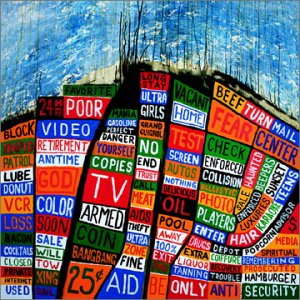
joys of music; and it is obvious on 2003s release, Hail to the
Thief. Not to say this is an album of twelve 3 minute pop songs nor
is it without darker moments. Rather, the sense of "imminent ice ages"
that was predicted on OK Computer and present on Kid A
and Amnesiac have had their polar ice caps melted.
The energy that is apparent on such tracks as '2+2=5' and 'Where I End
and You Begin' is a stark contrast to the various type of computer
driven energy on earlier album releases. They ensure a sense of human
driven rawness. They provoke a sense of relief that there is a human
operator behind the sportscar.
Songs such as 'We Suck Young Blood,' 'There There,' and "A Punchup at a
Wedding' give a unique melodious feel that only Radiohead can seem to
conjure up from the depths of musical limitations. 'We Suck Young
Blood's' sporadic clapping seems to almost represent a feel of a sense
of soul shackled to slavery. The type of clapping is most relevant to
American "slave" songs and is hauntingly reminiscent of O' Brother
Whereart Thou's chain gang intro. Elsewhere, 'There There' and
'Punchup at a Wedding' offer political accusations and misconceptions
with a droning sense of midtempo rock.
While the albums darker moments musically, 'Wolf at the Door,' 'The
Gloaming,' and 'I Will' still grasp that feeling of desperate
loneliness, it no longer leaves a vague and discontented ending. It's a
proactive stance. 'I Will' takes the side of an Iraqi family and their
perspective of the war. It tries to provide a human element to that
which most people view as a war against a single man rather than
affecting lives of average citizens. (side note, if you play 'I Will'
backwards, you get the melody for the basis of Spinning Plates.)
Though the album is one that leaves behind the cold and dark of
Radiohead's prior two releases it never really catches the same element
of raw rock that was so vibrant on The Bends. Not that the
intent of this album is to do so. Rather this album embarks on a
blending of change. It's not all computers and drum machines, it's not
all guitars and powerchords. Rather it is an ingenious blend of piano,
guitar, computer, drums and vocal harmonies that require multiple
listening sessions to fully comprehend both lyrical and musical ideals.
If you are afraid of change from the
happy-go-lucky-corporate-drivel, fear this album. If you are
optimistically looking for alternatives to the doldrums of the plethora
of fridge buzz emanating from the radio today, change looks good and
it's nice the voice of change has finally spoken.
Contributed 14 August 2003
If you wish to respond to the author, e-mail me jcboehm@freeshell.org
and I will post or pass along any responses, or put you in
touch with the author.